













College used to be the default next step after high school, but today, fewer students are enrolling than ever. What’s driving this shift? Why does this matter to CSS? At institutions like the College of Saint Scholastica, these broader national trends show up in real time through changing enrollment patterns, evolving student expectations, and increased competition for students weighing the cost and value of a college degree.
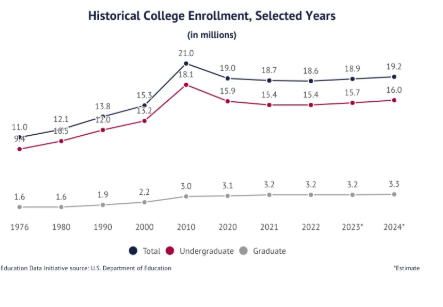
Elissa Nadworny, an NPR correspondent, has noted that the number of young adults pursuing college degrees has dropped significantly since 2010, nearly 15%. Though this drop may seem dramatic, it is not without reason. The biggest cause is that enrollment rates in 2010 had increased significantly since 2000. Undergraduate enrollment was nearly 13.2 million in 2000, much less than it became in 2010, with 18.1 million enrolling.
This increase followed the Great Recession, as job scarcity pushed more people toward college to stand out. As the job market improved and applicant competition decreased, fewer people applied. In response, companies began rethinking degree requirements; by 2024, only 44% required college degrees, down from 51% in 2017, shifting what people prioritize.
Many people want a job that will allow them to make enough money to live comfortably and to buy other things that they want. Previously, people who earned that type of money typically had degrees. The shift away from this requirement meant that people no longer needed a degree to earn this amount, making college less worthwhile.
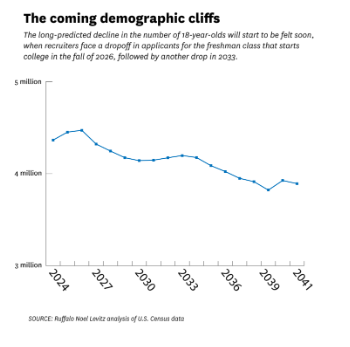
As Jon Marcus, a reporter at The Hechinger Report, mentions, another cause is that, overall, our population is decreasing. The number of college-age individuals has decreased in recent years. This is referred to as the “demographic cliff,” or the “enrollment cliff.” Essentially, it refers to the decline in the number of students enrolling in college, which is largely attributed to the sharp drop in birth rates that began in 2008. This, in turn, leads to fewer children reaching college age in 2026 and beyond.
With the sharp decline since 2010 in mind, the question now is what’s driving more people to bypass college and head straight into the workforce.
The primary reasons are the cost of tuition, the option of pursuing trades, and doubts about the return on investment. As for the cost of tuition, it has been increasing over the years; it’s now 40 times what it was in 1963. After adjusting for inflation, tuition has increased 312.4%, largely due to less government funding and lower enrollment.
For public institutions, government funding is very important to their ability to provide education. When funding decreases, colleges must find revenue elsewhere, often by raising tuition. At the same time, lower enrollment reduces income, creating a similar financial strain. Since tuition is a primary source of revenue, especially for private colleges, fewer students mean fewer resources to support education and services.
As for other options, many young adults are deciding not to go to college at all, or to go to trade school instead. There are lots of jobs available that don’t require college, so for some, it makes more sense to head straight into work. Those who wish to specialize are more often choosing trade school over college. Trades have become very important as the jobs they prepare for are in high-demand. These jobs often pay pretty well, and there is decreased opportunity for AI to be trained to do their jobs, leading to job security.
Overall, young adults have continuously been unsure if investing in a college education is really worth the price and the likely chance of student debt. This is especially true when prices are only getting higher due to a smaller young population and decreased government funding. The option of trade school instead has been increasingly appealing, as there is a certain amount of job security, as these jobs are in high demand and have a lower risk of automation by AI. Though college graduates still make more, often 86% more than those with only a high school diploma. It also allows for specialization, especially in vitally important careers like medicine.
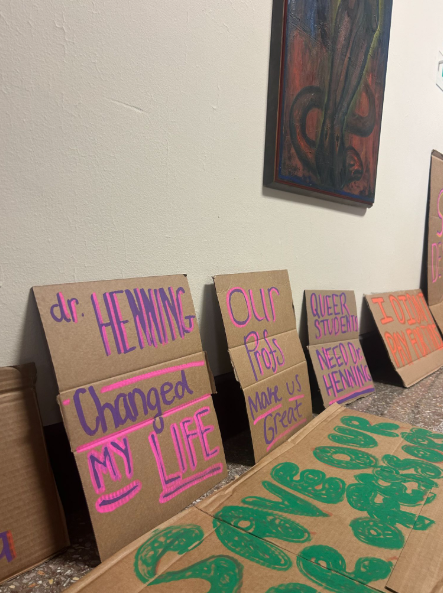
Finally, students’ perceptions of campus culture and personal fit influence whether they enroll in college at all. Beyond financial and economic concerns, many prospective students are making decisions based on whether they feel a sense of belonging or see themselves reflected in a campus community. At CSS, for example, students have reported that supportive faculty, available scholarship opportunities, and the campus’s location in Duluth are key reasons for their decision to enroll. These features help create a more personal and accessible college experience, which can make a significant difference for students who are weighing multiple post–high school paths. When students feel that a campus is both financially feasible and personally welcoming, they are more likely to commit to attending. This suggests that institutions that actively highlight and strengthen these kinds of connections may be better positioned to counter broader enrollment declines.
Works Cited
Hanson, Melanie. “College Tuition Inflation Rate.” Education Data Initiative, 9 Sept. 2024, educationdata.org/college-tuition-inflation-rate.
Marcus, Jon. “The Number of 18-Year-Olds Is about to Drop Sharply, Packing a Wallop for Colleges — and the Economy.” The Hechinger Report, 8 Jan. 2025, hechingerreport.org/the-impact-of-this-is-economic-decline/.
Nadworny, Elissa. “College ‘Sticker Prices’ Have Risen Dramatically. Here’s Why.” National Public Radio, 20 Nov. 2025, www.npr.org/2025/11/20/nx-s1-5600854/college-costs-have-risen-dramatically-in-the-last-20-years-heres-why.