
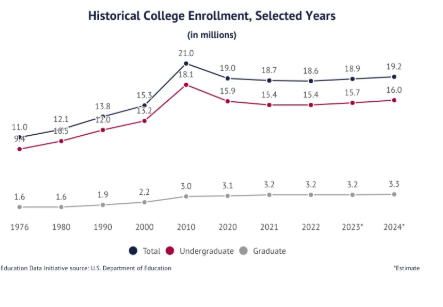














St. Scholastica’s student body is full of ambitious and driven individuals pursuing a wide range of careers, yet many are currently questioning whether a college degree is still worth the high price tag these days.
With tuition and fees for full-time undergraduates hitting $44,040 for the 2026-27 academic year — plus room, board, and other costs pushing the total annual bill near $58,000 — and median federal student loan debt for graduates hovering around $20,000, the return on investment feels uncertain for some.
Recent employment statistics and ROI analyses show that a bachelor’s degree still delivers strong long-term payoffs on average, but the results vary dramatically depending on the major. The answer to this uncertainty may have already been laid out in the latest data from the Georgetown University Center on Education and the Workforce.
Their October 2025 report, “The Major Payoff: Evaluating Earnings and Employment Outcomes Across Bachelor’s Degrees,” crunches the numbers on 152 majors and finds that prime-age workers (ages 25–54) with a bachelor’s degree earn a median of $81,000 — 70% more than workers with only a high school diploma. Unemployment for those college grads sits at just 2.9%, compared with 6.2% for high school graduates alone.
The report’s authors emphasize that the evidence overwhelmingly points to a bachelor’s degree as a worthwhile investment in the long run.
“Despite challenges like high costs and uncertain job prospects for recent graduates, the data consistently show that workers with a bachelor’s degree will earn more over their lifetimes than workers with only a high school diploma,” the report states.
Over a full career, that premium can translate into hundreds of thousands — even millions — of additional dollars, with one analysis projecting lifetime earnings for a 2025 bachelor’s graduate around $7.95 million before costs.
But the real story is in the breakdowns by major. STEM fields lead the pack, with median earnings for prime-age workers hitting $98,000. Architecture and engineering, business, computers/statistics/mathematics, health, and physical sciences all post the highest returns. Engineering, for example, consistently ranks among the top for ROI, with some analyses showing returns as high as 326% and starting salaries near $100,000. Computer science and IT majors often see similar trajectories, with early-career median pay around $79,000–$87,000 and strong mid-career growth. Healthcare fields also deliver solid outcomes, with median earnings near $105,000 for prime-age workers and low unemployment around 3.4% for recent grads.
On the other end, education and public service majors see median earnings of just $58,000 for prime-age workers, while some humanities and arts fields range from $58,000 to $73,000. Recent graduates in fields like fine arts, film/video/photographic arts, or anthropology can face unemployment rates as high as 7–11% in the first few years out, according to Federal Reserve Bank of New York data tracking 2025 cohorts.
Overall, recent college graduates (ages 22–27) are seeing unemployment around 5.3–5.7% in late 2025 — higher than pre-pandemic levels — and underemployment near 42%, though those numbers improve sharply with experience.
Despite not every major guaranteeing an immediate windfall, the gradual expansion of high-ROI fields in the job market has allowed many graduates to truly see the payoff. Business and finance degrees remain reliable, with steady job growth projected at 6–7% through the next decade and competitive starting pay. Economics majors, for instance, often start around $60,000 and reach mid-career medians near $130,000. Even lower-earning fields frequently still beat high school outcomes when viewed over a lifetime, and many students boost their returns with graduate degrees, which can more than double earnings in fields like health and medical preparatory programs (from $70,000 to $152,000 median).
The success of these data-driven insights shows promise for students navigating their own paths. In a landscape where costs are real but the long-term earnings premium holds steady — even after debt payments, degree holders still net about $8,000 more per year than those who started college but didn’t finish — the choice of major becomes crucial.
It is clear that there are a variety of career-minded students in the College of St. Scholastica’s student body, and making informed decisions based on employment outcomes and ROI could be the opportunity many of them have been waiting for.